 Záborszky
Záborszky
Záborszky
Since 1263 · Turóc County, Hungary
The Záborszky family is one of the oldest families of Hungary and the Carpathian Basin, and one that still counts many members today.
An ancient family of Turóc County, whose ancestors received a grant to the settlement of Zábor in Turóc County from King Béla IV in 1263. In 1364, János, son of Pál of Zábor, and his brothers Miklós, István and László, together with János, son of Tamás of Zábor, were confirmed in their estates by Jakab of Szepes, Judge Royal, upon presentation of their donation charters. In 1391, the aforementioned János, son of Pál, appeared before Imre Bebek, Judge Royal. The family took the name Záborszky from this settlement.
In time, branches of the family spread into other counties. Thus, by 1480 we already find Mihály Záborszky as captain of Tapolcsány Castle.
In Zala County, János Záborszky was already living in 1594; his wife was Margit Sárkány. From him may have descended the Miklós who in 1659 served as a royal commissioner sent to make good the damages suffered by the towns of Lőcse and Kézsmárk.
It appears that a branch of the Záborszky family crossed from Zala County into Somogy County, where it married into more prominent noble families and held property at Várda. The descent of this Somogy branch is as follows:
László; Mihály, 1808–1811, second deputy lord-lieutenant of Somogy County (m. N. Stefaics); Anna (m. Gáspár Mérey); Imre (m. Antónia Farkas); Miklós (m. Bora Mérey) †; Janka (m. Gusztáv Kund); Ambrus; Alajos, †1862, member of the Somogy delegation and public writer (m. Mária Majthényi); Amália (m. József Gludovacz); Ilona (m. Gyula Mérey); Béla, b. 1841 (m. Vilma Heller, from 1864).
Among those on this family tree, Mihály served as second deputy lord-lieutenant of Somogy County from 1808 to 1811. One of his sons, Alajos, became a lawyer and assessor of the county court at the age of 21. Around 1836 he wrote a short work titled "The Decline of Poland"; in 1841, a political pamphlet titled "Accusations against the Pesti Hírlap, and Progress" — at that time he was a correspondent for the Pesti Hírlap newspaper; in 1843, he wrote on the plans and benefits of the hereditary redemption of tenant land, and that same year he edited the parliamentary reports in Pozsony; around 1845 he wrote his political "Daguerreotypes"; in 1847 he became a financial counsellor; in 1848 he was elected a member of the National Assembly and also served as its secretary in Debrecen, later becoming a ministerial secretary and counsellor, and a government commissioner. In 1849 he was sentenced to death, but was saved by a severe illness (during which Haynau was removed from his post). In 1861 he was elected representative for the district of Lengyeltóti, but once again could not accept the seat due to serious illness. That year his last work appeared, titled "The Shadows of Austrian Politics." He died on 5 April 1862, leaving one son: Béla.
From the Turóc County branch of the family we know of György Z., from around 1670, whose son by Zsuzsanna Draskóczy of Milko was Dániel Z., whose daughter by his wife Éva Jeszenszky of Nagyjeszen was Zsuzsanna Záborszky, wife of Mihály Prónay, around 1707.
A branch of the family also lived in Trencsén County, which, according to the noble censuses, held curial property there in 1690. In 1803 Imre lived at Melcsic; in 1837, the younger Imre at Melcsic, and János and György at Závod.
In Nógrád County, in the settlement of Korlát, Antal lived at the beginning of this century; in 1805 he moved his residence to the settlement of Síd in Gömör County, where he still held property in 1815. Likewise in Nógrád County, at Balassagyarmat, a few members of the Záborszky family were also living in 1840.
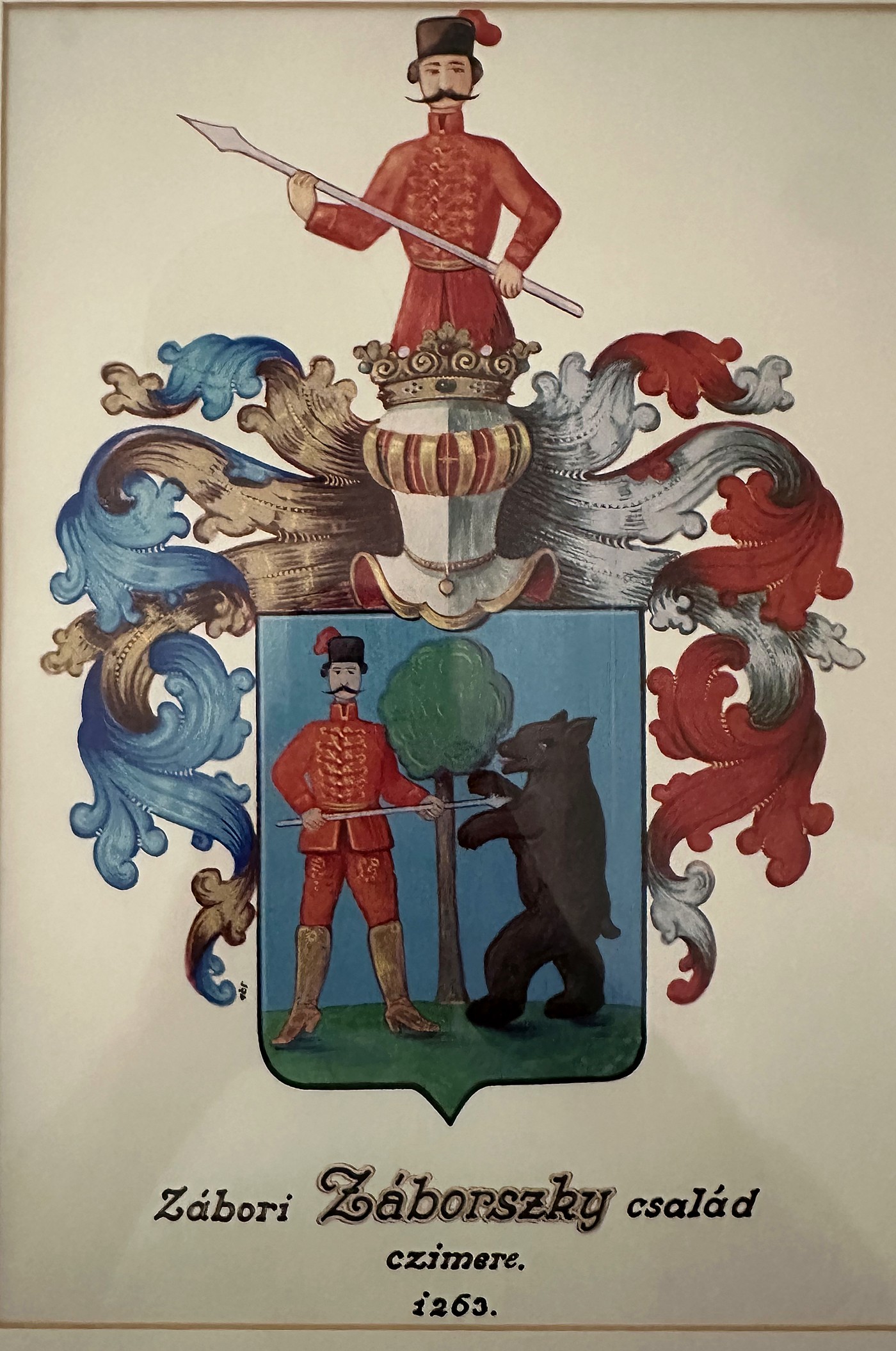
Its coat of arms: in the shield's blue field, on a green terrain, beneath a tall, spreading green tree, stands on one side a rearing lion pierced through the neck by an arrow, and on the other a Hungarian warrior with a sword. From the crown above the helmet atop the shield rises likewise a Hungarian warrior, holding an arrow in his right hand. In the seal of the Somogy branch (as far as could be made out), the shield's field beneath the tree would show two rearing animals; and from the crown above the helmet a spreading tree rises up.
Translated from period Hungarian noble family records, unchanged in substance.
The family took its name from the settlement of Zábor in Turóc County, where its ancestors received a land grant from King Béla IV in 1263.
In 1263, from King Béla IV of Hungary, for the settlement of Zábor in Turóc County.
Over the centuries, branches of the family settled in Turóc, Zala, Somogy, Trencsén and Nógrád counties.
On a blue field, beneath a spreading tree on green ground, stands a rearing lion pierced through the neck by an arrow on one side and a sword-bearing Hungarian warrior on the other; the crest above the helmet likewise shows a Hungarian warrior holding an arrow.